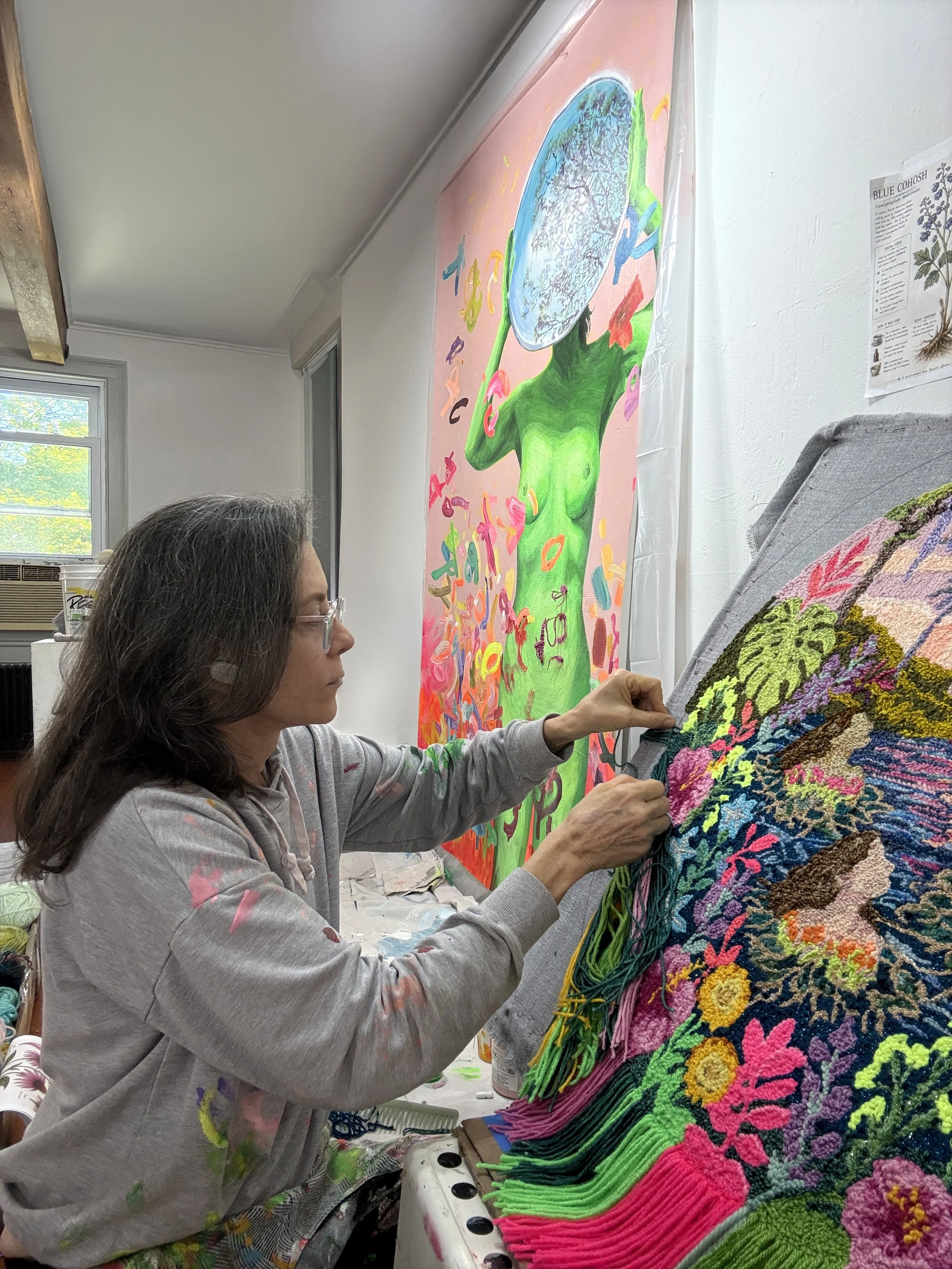
Dana Donaty is a South Florida–based artist whose work explores the experience of inhabiting a body shaped by illness through fiber, painting, sculpture, and installation.
Artist Statement
Illness fractures our sense of belonging in the world. I make work that asks what it means to inhabit a body shaped by illness. Grounded in lived experience, my work connects personal illness to broader questions of women’s health, care, and systemic inequity. Using vibrant color and maximalist aesthetics, I create fiber works, paintings, and installations that draw on the body as a source while engaging histories of how women’s bodies, labor, and knowledge have been overlooked and undervalued within medicine. My work unfolds through punch needle, layering, stitching, and accumulation guided by the changing capacities of my body. Making becomes a way of giving form to experiences that resist easy language, and of finding meaning and belonging within them. A symbolic, high-saturation palette insists on the excruciating pleasure of being alive. Grievance, grief, and gratitude form the emotional framework of my practice, allowing heartache, humor, rage, and joy to coexist within the same image.
Bio
Dana Donaty (b. 1966, Columbus, Ohio) is a Colombian-American artist based in South Florida. She holds a BFA from Moore College of Art & Design and an MFA from the School of Visual Arts. Her practice spans fiber, painting, sculpture, and installation, connecting her lived experience of illness to broader questions of women’s health, care, and systemic inequity.
Donaty has received grants from the Adolph & Esther Gottlieb Foundation, the Robert Rauschenberg Foundation, and CERF+; a Residency Fellowship from the Vermont Studio Center; and has been awarded residencies at ChaNorth, The Arts Warehouse, Bakehouse Art Complex, South Florida Ford, and Kriti Gallery.
Her work is held in the permanent collections of the Coral Springs Museum of Art, the Satell Family Foundation, Cricket Taplin, Palm Beach County Art in Public Places, Boynton Beach Art in Public Places, and West Palm Beach Art in Public Places.
Selected solo exhibitions include Moore College of Art & Design (Philadelphia, PA), Coral Springs Museum of Art (Coral Springs, FL), Cornell Museum of Art (Delray, FL), and South Florida Ford (Miami, FL), with a forthcoming solo exhibition at The Arts Warehouse (Delray, FL). Selected group exhibitions include The Invisible Dog Art Center (Brooklyn, NY), Penn + Brush (New York, NY), Hera Gallery (Wakefield, RI), The Camp Gallery (Miami, FL), the Mexican Consulate (Miami, FL), Coral Springs Museum of Art (Coral Springs, FL), Flatiron Gallery (New York, NY), Wavelength Space (Chattanooga, TN), the Cultural Council for Palm Beach County (Lake Worth Beach, FL), and Art and Culture Center Hollywood (Hollywood, FL).